


Comparative Evaluation of Aporia® Ergonomic Cushions for Pelvic-Perineal, Coccyx, and Lower Back Comfort
Meta Description: The Pelvi-Seat study conducted by Nantes University Hospital compares Aporia® ergonomic cushions with traditional chairs for pelvic-perineal, coccyx, and lower back discomfort while sitting. Results report improved perceived comfort and reduced perceived pain with Aporia® cushions.
Preliminary Disclaimer by Blue Portance (outside the hospital study).
It is important to note that the testing time used in this study only measures immediate feedback. As with any ergonomic solution, proper adjustment of the seating and learning how to use it are essential to ensure optimal comfort and longer-term support. Much like a shoe that must adapt to your foot, using Aporia® ergonomic seating requires an adaptation period. This is why we offer a one-month trial period, after which more than 80% of our customers choose to keep their Aporia® seat.
The tests did not include the adaptive shims normally provided with Aporia® cushions by Blue Portance. These shims allow for a personalized adjustment to each user’s pelvic-spinal profile. Their absence may underestimate the actual effectiveness of the cushions in terms of comfort and perceived pain reduction.
Context and Objective of the Nantes University Hospital Pelvi-Seat Study: Addressing Pelvic-Perineal, Coccyx, and Lower Back Discomfort
Pudendal neuralgia, coccyx pain, and low back pain: disabling conditions in a seated position
Pain associated with the pudendal nerve (pudendal neuralgia), the cluneal nerve (cluneal neuralgia), and the coccyx (coccygodynia) is common among patients followed at Nantes University Hospital. This pain is often accompanied by low back pain, making it difficult to maintain a prolonged seated position, thereby affecting patients’ quality of life during everyday activities such as meals, commuting, or work.
Medical recommendations include using ergonomic seating to relieve painful pressure points, as well as effective postural support to reduce tension in sensitive areas.
Why choose Aporia® ergonomic cushions to relieve pelvic-perineal and coccyx discomfort?
Based on preliminary trials conducted in 2022, Aporia® cushions stood out for their ability to provide dynamic postural support and pressure offloading in painful areas such as the pudendal nerve and the coccyx. Designed around a flexible, multi-articulated structure, these ergonomic cushions adapt to the user’s movements, helping to support sustained comfort.
Although Aporia® cushions are not medical devices, they are specifically designed to relieve sitting discomfort in pelvic, coccygeal, and perineal areas, while offering prolonged comfort for people living with chronic pain.
Pelvi-Seat study methodology: comparative evaluation of Aporia® ergonomic seating
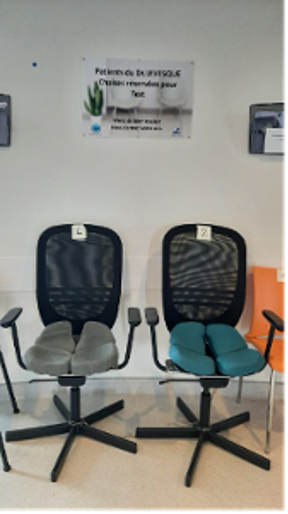
To measure the effectiveness of Aporia® cushions compared with traditional seating, the study tested four types of seats:
- A hard seat (Chair 1),
- A padded seat (Chair 3),
- An Aporia® cushion designed to relieve perineal pain (Chair 2),
- An Aporia® cushion dedicated to coccyx pain (Chair 4).
Each patient tested these seats for 15 minutes and then completed an evaluation questionnaire. Evaluation criteria included perceived pain, comfort, postural support, and the discretion of the device.
Study population characteristics: a representative sample of patients with pelvic-perineal pain
The study was conducted with 95 patients. The population was predominantly female (82%) with a median age of 45 years. Fifty-five percent (55%) of participants had a standard BMI, while 40% had a high BMI, including overweight and obesity. All patients experienced pelvic-perineal pain, with a majority reporting coccyx pain (65%), pudendal nerve pain (50%), and cluneal nerve pain (25%). The diversity of profiles ensures that the results are representative of patients affected by these conditions.
Key Results of the Pelvi-Seat Study: Satisfaction, Perceived Pain, and User Preferences
Previous use of ergonomic cushions: dissatisfaction with existing solutions
Among participants, 47% already used an ergonomic cushion for sitting, but only 11% reported being satisfied with their current cushion. Most users (64.4%) hoped for better pain reduction, while 42% sought improved ergonomics, 25% better comfort, and 20% improved postural support. In addition, 27% of users placed high importance on the discretion of the device, indicating the need for a cushion suitable for professional and social environments.
Overall satisfaction with Aporia® ergonomic cushions for coccyx pain and pudendal nerve pain
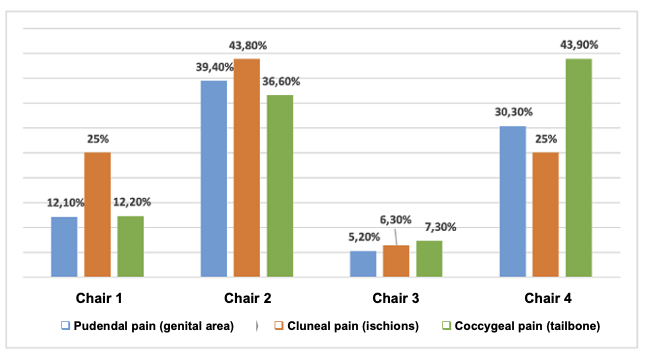
Results showed significant dissatisfaction with traditional chairs, with dissatisfaction rates of 69% for hard chairs and 79% for padded chairs. In contrast, Aporia® cushions were widely appreciated: the coccyx version received 63% satisfaction, while the perineal version obtained 59% satisfaction. These results are particularly notable given the prevalence of coccyx pain among participants.
Significant reduction in perceived pain with Aporia® cushions: effectiveness for coccyx and perineal pain
A majority of participants found hard and padded chairs painful (69% and 79%), but Aporia® cushions significantly reduced perceived pain: 45% of users reported no pain with the coccyx version, and 38% reported a reduction in pain with the perineal version.
User preference: Aporia® cushions widely favored
Aporia® cushions dominated satisfaction rankings. The perineal version obtained 77% of votes among the top two positions, while the coccyx version received 67%. Primary reasons included pain reduction (73%), optimized postural support (43%), and ergonomics (40%).

Prolonged comfort with Aporia® cushions: notable improvement but limitations over time
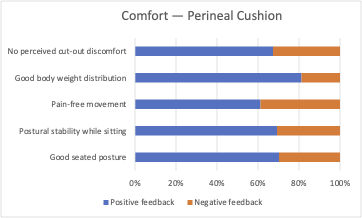
After an initial phase of short tests, patients performed a 4-minute extended test on Aporia® cushions. Fifty-four (54) patients preferred the perineal version, and 40 preferred the coccyx version. An overall improvement in comfort was observed, with positive opinions ranging from 65% to 80% for the perineal version and from 58% to 70% for the coccyx version. However, discomfort was reported after prolonged sitting: 63% of perineal users and 53% of coccyx users reported discomfort after 4 minutes.
Perception of the cut-out: mixed feedback on Aporia® ergonomic cushions
The cut-out in the cushions, designed to relieve pressure on sensitive areas, was perceived as uncomfortable by 31% of perineal users and 40% of coccyx users. A majority (59% to 69%) felt the cut-out was not wide enough, which may explain this discomfort.
Range and fluidity of movement: Aporia® cushions facilitate movement
Aporia® cushions were judged very effective in facilitating movement. Only 12% of perineal users and 17% of coccyx users reported limitations in range of motion. Regarding movement fluidity, 92% of perineal users and 83% of coccyx users reported fluid, effortless movements.
Conclusion by Blue Portance (outside the hospital study).
Results from the Pelvi-Seat study show that Aporia® ergonomic cushions provide significant relief for pelvic-perineal and coccygeal discomfort, with a notable reduction in discomfort associated with prolonged sitting. Thanks to their multi-articulated structure combining dynamic postural support and pressure reduction, these cushions meet user expectations for comfort, relief, and mobility.
At Blue Portance, we believe our Aporia® ergonomic cushions offer an effective response for challenges such as pudendal and cluneal sensitivities, coccyx discomfort, or lower back tension. The high satisfaction rate and positive feedback from our customers after a trial period confirm the importance of gradual adaptation to fully benefit from the ergonomic effects of our products.
Our commitment: to continue innovating and offering ergonomic solutions that contribute to improving quality of life for people living with chronic discomfort.