


RELIEVE PUDENDAL NEURALGIA: STOP WASTING TIME ON CUSHIONS THAT MISS THE ESSENTIAL
🧩 Aporia® acts where conventional cushions fail
Most cushions marketed for perineal pain rely on two principles:
- Localized offloading through a central cut-out,
- Memory foam to absorb and statically distribute pressure.
But these solutions remain static. Pudendal neuralgia is a complex, chronic condition that cannot be sustainably improved without addressing the deeper drivers of pain.
Drivers that are often combined: postural imbalance, neuromuscular tension, restricted pelvic mobility, tissue dynamics…
They require an active and structured response, far beyond simple offloading.
This is the challenge Blue Portance tackles with the Aporia® Perineal cushion.
Take the challenge with Blue Portance
Try Aporia® Perineal🧩 The functional attributes that make the difference
Thirteen functional attributes are needed to address the full complexity of perineal pain — most cushions cover only two
Standard cushions typically provide only 2 attributes: direct pressure offloading (cut-out) and static pressure distribution (memory foam).
The 11 additional attributes are what change everything.
📱 Tap each attribute to see the details
1. Elimination of direct compression
Standard: ✅ Often oversized cut-out
Aporia®: ✅ Anatomically calibrated cut-out
👉 Less direct contact on the perineum can reduce symptoms quickly — but not reliably over time without addressing deeper mechanisms.
2. Reduction of internal reflex compressions
Standard: ❌ Reflex tensions ignored: seated posture reactivates compensation chains
Aporia®: ✅ Active release of reflex postural tension via self-regulated micro-movements
👉 The pudendal nerve is no longer trapped and irritated by postural compensation patterns.
3. Static pressure distribution
Standard: ✅ Uniform (memory foam)
Aporia®: ✅ Uniform (memory foam)
👉 Surface comfort — often insufficient for deep, persistent perineal pain.
4. Dynamic pressure distribution
Standard: ❌ Pressure concentrates under constraint
Aporia®: ✅ Homogeneous support ensured by the Aporia® Exobase structure
👉 Pressure remains distributed even with shifting: perineum, ischial areas and glutes are not overloaded.
5. Stable postural balance
Standard: ❌ Unstable — one “acceptable” posture only
Aporia®: ✅ Every seated position remains balanced (less load on the perineum)
👉 Perineum and deeper pathways (including Alcock’s canal and the pudendal nerve) are no longer forced into a single posture: pressure peaks decrease and postural harmony supports the whole neuromusculoskeletal chain.
6. Adaptive micro-movements
Standard: ❌ Fixed posture
Aporia®: ✅ Continuous micro-movement within a cone of stability
👉 No more prolonged fixed constraints that feed chronic inflammation.
7. Reduction of muscular tension
Standard: ❌ Balancing/compensation tensions persist
Aporia®: ✅ Tensions decrease through permanent equilibrium
👉 The perineal region stops being the convergence zone of parasitic muscular tensions.
8. Adaptation to spinal profile
Standard: ❌ Imposed lumbar/pelvic profile
Aporia®: ✅ Wedge system to adapt to the 3 main profiles (arched back, flat back, neutral)
👉 Better lumbopelvic alignment reduces chronic imbalance and reflex tension.
9. Deep tissue gliding
Standard: ❌ Compressed, static tissues prone to inflammation
Aporia®: ✅ 4 independent pads support tissue gliding, reducing tension and adhesions
👉 Tissue gliding in and around the pelvic floor helps reduce adhesions (muscles, fascia, tendons, nerves…) along sensitive pathways (including Alcock’s canal), and may decrease accumulated tension.
10. Pelvic stimulation
Standard: ❌ Pelvis is fixed; pelvic floor becomes static
Aporia®: ✅ By restoring hip and pelvic mobility, Aporia helps reintroduce motion to anchored pelvic structures
👉 More effective activation of deep pelvic floor musculature, crucial for pelvic support and functional control. Mobility can reduce compression chains affecting the pudendal nerve.
11. Deep blood flow support
Standard: ❌ Vessels may be compressed
Aporia®: ✅ Tissue dynamics can promote microcirculation
👉 Better pelvic floor and fascial mobility may support blood flow, reduce local stagnation, and help the tissues recover.
12. Gentle support of pelvic floor muscle tone
Standard: ❌ Muscles remain “locked” by static sitting
Aporia®: ✅ Muscles stay gently and continuously engaged
👉 Soft, ongoing stimulation supports immediate reflex responses to posture changes without overload — improved adaptability and maintained pelvic health may improve sitting tolerance.
13. Extended sitting tolerance
Standard: ❌ Limited
Aporia®: ✅ > 4 hours (varies by user)
👉 The perineal complex can better tolerate prolonged sitting — at work or in the car — while supporting recovery conditions over time.
Stop wasting time on cushions that miss the essential!
Try Aporia® Perineal⚙️ The key mechanisms for perineal pain
Pudendal neuralgia: why you must address both posture and tissue physiology
With pudendal neuralgia, pain rarely comes from a single “compression point.” It often reflects a complex chain: reflex postural compensations, deep muscular tension, reduced pelvic mobility, altered fascia dynamics, and chronic inflammation.
To break this cycle sustainably, you need to restore dynamic postural harmony and functional tissue physiology. Aporia® is the only seating system designed to act on both dimensions at the same time.
-
A. Posture & movement
Dynamic balance — movement within stability
The first prerequisite is to free the body from joint and muscle tension. This can only happen when the body is balanced. The Aporia® Exobase does exactly that: it turns every seated position into a balanced posture—without “thinking about posture”—so tension can drop while you keep moving within a stable base.
🔍 Why dynamic postural harmony matters in pudendal neuralgia
The smallest postural disorder can trigger deep compensations around the pelvis and pelvic floor. Those reflex tensions can maintain continuous pressure and irritation along sensitive neural pathways.
Only stable posture with micro-movement allows the body to release these tensions without voluntary effort. The Aporia® Exobase is multi-articulated and “bioactive”: it responds to micro-movements and self-regulates in real time. This is how Aporia® delivers movement within stability.
Homogeneous dynamic pressure redistribution
With each micro-movement, pressure redistributes. The Exobase follows your shifts and helps prevent localized compression peaks.
Adaptation to spinal profile
Flat back, arched back, or neutral: Aporia® adapts to preserve lumbopelvic balance across profiles.
-
B. Neuromuscular & tissue dynamics
Reduction of internal reflex compressions
Built-in micro-movements help release muscular chains reflexively, without conscious effort. Over time, sensitive structures can experience less sustained tension and compression.
Deep tissue gliding
Gentle mobility helps restore fascial fluidity and deeper circulation. This can reduce restrictions and support tissue recovery.
🔍 Why tissue gliding matters for the pudendal nerve (and cluneal nerve)
1. Preserving nerve mobility
The pudendal and cluneal nerves travel through anatomical tunnels (such as Alcock’s canal) surrounded by fascia. Normally, this fascia allows the nerve to glide with motion. When gliding is restricted (adhesions, fibrosis, chronic inflammation), the nerve can become mechanically stressed during posture changes.- Compression during movement and posture change,
- Burning, pulling, or electric-shock sensations,
- Reflex muscular tension that reinforces the vicious cycle.
2. Reducing adhesion risk after surgery or trauma
Gliding helps avoid abnormal “bridges” between tissue layers—especially after:- pelvic floor or perineal surgery,
- traumatic falls,
- childbirth with tearing or episiotomy.
3. Supporting microcirculation
Capillaries run through fascial layers. Healthy gliding can provide a gentle tissue “massage” effect that supports:- microcirculation,
- drainage,
- lower local stagnation and inflammatory load.
Pelvic mobility & pelvic floor tone
Greater hip freedom helps pelvic floor-related muscles regain coordinated contraction/relaxation. Continuous micro-movements can support active tone without voluntary effort.
-
C. Inflammation & recovery conditions
Exiting the chronic irritation cycle
With sustained compression, tension, and reduced circulation, sensitive structures can enter a chronic irritation loop. Aporia® aims to reverse key drivers by combining:
- ✔️ Fascial/tissue gliding support (mechanical easing),
- ✔️ Drainage/microcirculation support (chemical soothing),
- ✔️ Postural mobility (reduced reflex tension).
Result: sitting becomes more tolerable, tissues regain functional dynamics, and irritation can progressively calm.
Stop wasting time on cushions that miss the essential!
Try Aporia® Perineal🧪 Evaluated at Nantes University Hospital
✅ Evaluated at Nantes University Hospital — clinical evaluation conducted with ~100 patients under the supervision of Dr. Amélie Levesque, pain specialist and head of the pelvic pain consultation service.
Nantes University Hospital is widely recognized for pelvic and perineal pain care and internationally known for the “Nantes Criteria,” used worldwide to support the diagnosis framework for pudendal nerve entrapment.
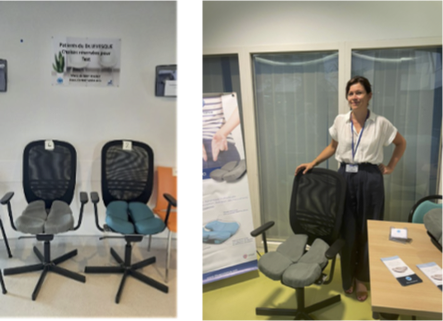
- Chairs equipped with Aporia® Perineal seating in the waiting room of the external consultation service (right). Dr. Amélie Levesque at the Blue Portance booth during the 4th International Symposium on Coccydynia (right).
Don’t wait any longer.
Try Aporia® Perineal💬 The people who explain it best
“The Blue Portance perineal cushion”
The Blue Portance perineal cushion helped me eat while seated, do DIY activities, and most importantly drive again.
Pure happiness — and I just ordered the perineal stool.
Béatrice D.
Postpartum pudendal neuralgia
“My second-skin seat”
Completely satisfied with Aporia seating. It follows me everywhere. It has become a second skin.
After a painful condition and surgery, I could no longer sit. Aporia is the only seating that gave me back the simple joy of shared meals at the table, and the autonomy of driving again… in short: getting my life back.
Christelle A.
Post-operative perineal pain
Like Béatrice and Christelle, reclaim your sitting comfort.
Try Aporia® Perineal🔵 Try Aporia® Perineal for 30 days
Comfort, mobility, and balanced posture — even during prolonged sitting.
Try Aporia® PerinealI prefer a seat that integrates the Aporia® Perineal version
Explore the seating options🔍 Key takeaway
-
Aporia® doesn’t just offload — it supports active, adaptive physiology.
That’s why sitting becomes tolerable again.